India just broke a wind energy record. Here's what it actually means.
In April 2026, the Ministry of New and Renewable Energy announced that India had added 6.05 GW of wind power capacity in FY 2025–26 — the highest annual addition in the country's history. A 46% jump over the previous year. A milestone that pushed India's cumulative installed wind capacity past 56 GW, cementing its position as the world's fourth-largest wind market.
Source: MNRE press release, April 2026 · Enerdata, April 2026 — "India achieves highest-ever annual wind capacity addition of 6.05 GW in FY 2025–26"The headlines were celebratory. And they should be — this is a genuine achievement, the product of years of policy work, competitive bidding, transmission investment, and project execution by thousands of people across the energy value chain.
But nobody at the press conference asked the operational question. The one that every logistics head, every ODC contractor, every EPC project coordinator already knows the answer to — but rarely says out loud.
Who is coordinating all of this? And how?
Here is the logistics math behind the milestone. 6.05 GW of installed wind capacity means approximately 2,000 turbines commissioned in a single financial year. Each turbine requires three blade transport movements. That is roughly 6,000 blade trips across India's state highway network in twelve months — moving 55–85 metre components that are literally longer than commercial aircraft, through roads designed for 12-metre trucks, across 29 states with 29 different permit regimes.
Add tower sections, nacelles, hubs, and balance-of-plant movements, and the total ODC movement count for FY26 comfortably exceeds 25,000 individual truck dispatches. Each one requires a permit. Each one requires a cleared route. Each one requires someone to know, in real time, where that vehicle is and whether the route ahead is safe.
Now ask the question again: who is coordinating all of this?
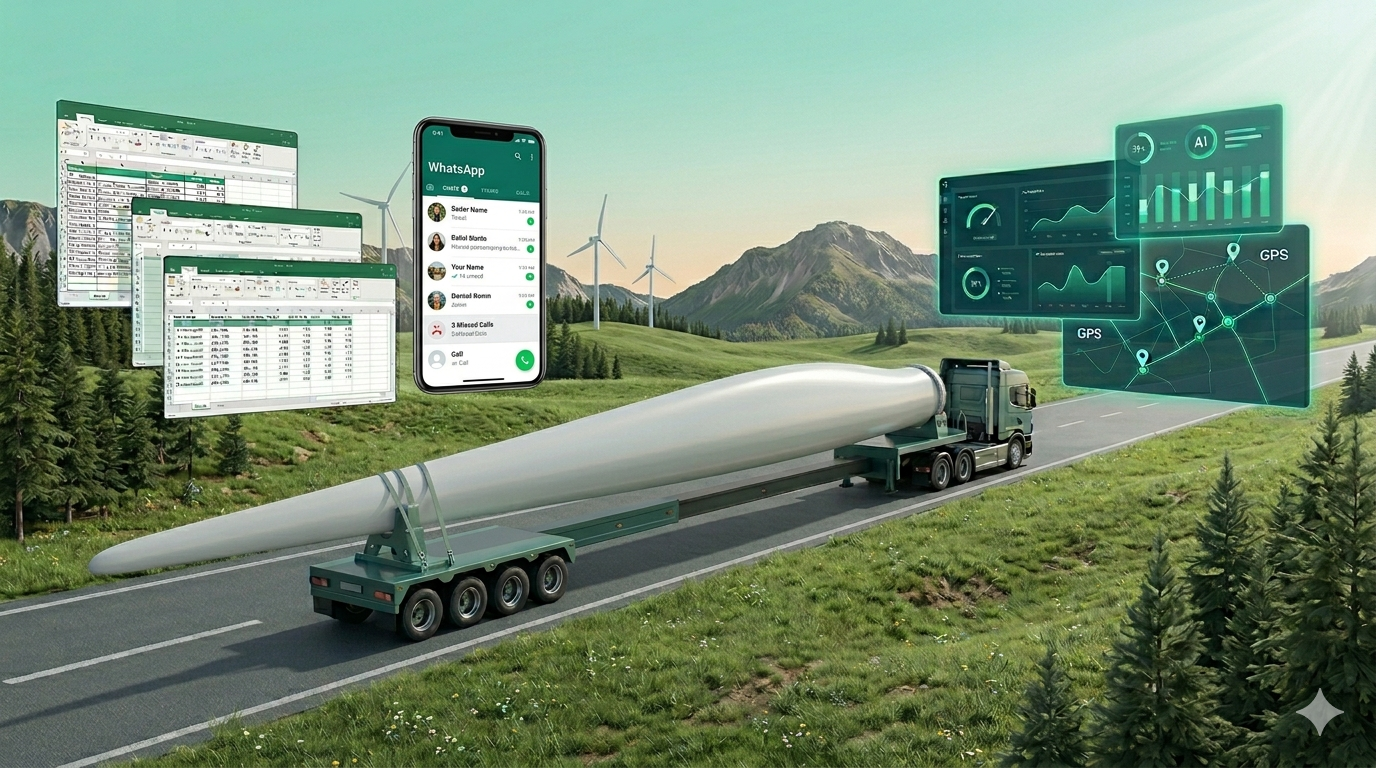
The answer, across most of India's wind logistics operations today, is: a logistics coordinator with a phone, three open WhatsApp groups, and a shared Excel file that is already out of date.
11 PM. Rajasthan. Three WhatsApp groups.
It is 11 PM. Somewhere in Rajasthan — in a hotel room, a vehicle parked at the edge of a laydown area, or an office in the nearest town — a logistics coordinator is staring at his phone.
He has three WhatsApp groups open. One for his surveyor team, scattered across two routes. One for the EPC project manager sitting 400 kilometres away at the site. One for the convoy of blade carriers — six trucks, somewhere on National Highway 62, whose lead driver last checked in forty minutes ago.
His WhatsApp has 73 unread messages. He is not going to read all of them tonight.
What he is trying to do right now, at 11 PM, is answer a single question: is tomorrow's route clear? One of his surveyors did the field assessment last week. The surveyor sent photos — 140 of them — into the group. The photos are unlabelled. They have no GPS coordinates attached. The photo of the bridge that concerned him is somewhere around message 67 in a thread of 140 images. The surveyor, when called, explains that the bridge is at roughly km 34 on the NH62 service road, but he can't remember the exact chainage, and his handwritten field notes are in the vehicle, which is parked at his hotel.
The EPC project manager wants a confirmed route clearance by 7 AM so the convoy can move at first light. The coordinator has an Excel file — route name, surveyor name, date, a column called "Status" with options: Survey Done, Clearance Pending, Cleared, Issues Found. The bridge is listed as "Issues Found." Nobody has updated it since last Thursday.
The DISCOM engineer who approved the line-raising on the power cable at km 28 sent a confirmation on WhatsApp ten days ago. It is somewhere in the surveyor group chat. He will need to scroll back through 600 messages to find it. If he can't find it, he will call the DISCOM engineer at 7 AM and hope he answers.
"The problem is never the surveyor's competence or the coordinator's effort. The problem is that every piece of critical information — clearance measurements, DISCOM approvals, bridge assessments, permit numbers — lives in the wrong place. It lives in a chat thread, not a database."
If the coordinator gets it wrong — if the bridge clearance was actually insufficient, or if the DISCOM crew doesn't show up to raise the line in time — the convoy arrives and stops. A blade carrier, 85 metres long, 40 tonnes loaded, sitting on a state highway at 4 AM with nowhere to go.
The crane at the site has been booked for 6 AM. Crane standby costs ₹8–12 lakh per day. The EPC project manager calls the IPP's project head. The project head calls the EPC CEO. Everyone is on a call at 5 AM asking the same question: what happened?
What happened is that the coordination infrastructure didn't exist to prevent it. This is not a story about one bad night. This is every project, everywhere in India, right now.
This is not an India problem. It's a documented global crisis.
What feels like a local, improvised dysfunction is a globally documented operational failure mode. The evidence has been building for over a decade.
What the US government found in 2014
In 2014, the National Renewable Energy Laboratory (NREL) — the primary research arm of the US Department of Energy — published a technical report on transportation and logistics challenges in wind energy. The opening line of the findings section:
"There is relatively little literature that characterizes transportation and logistics challenges and the associated effects on U.S. wind markets." The study relied primarily on interviews with project developers, OEMs, and transportation companies — because the structured data simply did not exist.
That was twelve years ago, in the United States — the world's second-largest wind market. In 2016, NREL followed up with a dedicated permitting and regulatory review. The findings: state regulations vary widely in permitting thresholds, escort requirements, route survey processes, and the use of digital permit systems. Various industry groups had sought to harmonise requirements. No uniform standard had emerged.
Levine, A. and Cook, J. (2016). Transportation of Large Wind Components: A Permitting and Regulatory Review. NREL Technical Report NREL/TP-6A20-66998.Replace "50 US states" with "29 Indian states" and the description is identical. Karnataka requires applications to the District Transport Officer in each district the vehicle crosses — meaning a single truck on a 300 km route through three districts needs three separate permit applications. Tamil Nadu has the highest cumulative wind capacity of any Indian state and some of the slowest permit processing. Railway level crossing approvals sit with 29 different Divisional Railway Managers. No unified system exists.
What European researchers confirmed in 2024
In December 2024, a peer-reviewed study published in MDPI Energies applied FMEA (Failure Mode and Effects Analysis) methodology to oversized wind turbine transport. Researchers surveyed 11 companies across Poland and Europe, conducted field observations, and ranked 15 risk categories by severity.
The two highest-priority risks, requiring immediate action, were:
- Road accidents involving vehicles transporting oversized loads
- Discrepancies between the actual dimensions of the cargo and the transport documentation
The documentation discrepancy risk — number two on the global risk priority list — is precisely what India's field teams manage today with WhatsApp photos and handwritten field notes. A surveyor measures a bridge clearance manually, records it in a notebook, transcribes it into a WhatsApp message, which is then manually entered into an Excel cell. Each transfer is an opportunity for error. Each error is a potential convoy stoppage.
Why WhatsApp won. And why it wasn't wrong — then.
The question worth asking is not "how did this happen?" but "why hasn't it changed?" The answer requires understanding how the industry actually grew.
The industry scaled faster than its infrastructure
India's wind sector went from a niche experiment in Tamil Nadu to a national infrastructure priority in under fifteen years. The contractors, surveyors, EPCs, and logistics coordinators who built the industry did so in an environment where speed mattered more than standardisation, and where the tools available were whatever everyone already had.
WhatsApp was — and still is — genuinely functional for small-scale coordination. When a logistics contractor is managing three routes and two surveyors, a WhatsApp group works. Everyone is reachable. Photos get shared. Decisions get made. The friction is manageable.
The problem is that the industry scaled by replicating the same model — three more surveyors, three more WhatsApp groups, one more Excel file — rather than by replacing it. Today, a logistics head managing 8 simultaneous projects across three states has not four WhatsApp groups but forty.
The fragmentation is structural, not accidental
The deeper issue is that there is no shared data infrastructure across the Indian wind logistics value chain. A logistics contractor captures route survey data. An EPC project manager tracks delivery schedules. An OEM monitors component dispatch from the factory. Each stakeholder manages their own information in their own format, and the interfaces between them are phone calls and WhatsApp messages.
A 200 MW wind project with 60–70 turbines requires 400–500 individual ODC movements, each requiring a permit. For multi-state routes, each movement may require 3–5 simultaneous state permits. Karnataka: permits from every district RTO on the route. Tamil Nadu: 15–25 day processing standard. Railway level crossing approvals: 4–12 weeks — often the single longest approval on the critical path, and the one most routinely discovered late.
What this costs. In actual money.
The financial cost of India's logistics coordination gap is real and substantial. It doesn't appear as a line item in anyone's budget — it's dispersed across repeat surveys, idle crane days, penalty clause triggers, and coordinator salaries spent on status update calls. Here is what it runs to.
In the absence of a structured route database, the standard practice when a project team needs the same corridor for a new project is to re-survey from scratch. One repeat survey costs 2–4 days of surveyor time, vehicle costs, and accommodation. On a 300 MW project with 50+ routes, even five repeats is ₹5–10 lakh gone — absorbed as "mobilisation cost" rather than attributed to the coordination failure it actually is.
When a convoy stops because a bridge was misassessed, or a DISCOM crew didn't arrive to raise a power line on schedule, the crane standing by at the site doesn't pause its billing. Crane standby costs ₹8–12 lakh per day. A single stopped day cascades to a week-long schedule slip. For the IPP, a 30-day delay to commissioning affects the project's IRR by 0.3–0.5 percentage points. On a ₹1,700 crore wind project, that is ₹50–80 crore in NPV impact — directly attributable to a coordination failure.
The average logistics management team handling multiple wind projects spends 30–40% of their coordination time on status updates — calls, messages, and emails that produce no operational output. A logistics manager handling 8 simultaneous projects is losing 2–3 hours every working day answering the question "where is the survey?" The transport cost baseline for a 200 MW project is ₹18–50 crore in ODC movement alone. A 5% coordination inefficiency on that baseline is ₹90 lakh–₹2.5 crore in recoverable cost.
Two workflows. Same industry. Different outcomes.
The difference between what India's wind logistics teams operate with today and what a structured workflow looks like is not a technology difference. It is a data infrastructure difference. Here is what each looks like, step by step.
| Workflow step | Current — WhatsApp & Excel | Structured — digital route intelligence |
|---|---|---|
| Field data capture | Photos on personal phone. No GPS tag. No label. No context at point of capture. | GPS-tagged photo at point of observation. Clearance measured and recorded in structured field immediately. |
| Data transfer to team | WhatsApp dump of 100+ photos. PM calls surveyor 10–15 times to interpret each one. | PM opens live route dashboard. Every observation visible, geolocated, with photos attached. Zero calls for status. |
| Route survey report | Manual Excel/Word built after a 12-hour field day. Takes 6–8 more hours. Becomes a PDF. Gets filed. Gets lost. | Digital report generated in one click. Timestamped, permanently stored, searchable, shareable as a live link. |
| Route reuse | Same corridor, next project — old report is missing or not trusted. Surveyor re-drives the full route. | Pull existing route data. Update only what's changed. Repeat surveys eliminated for known corridors. |
| Permit status | Excel column. Updated manually when someone remembers. Often stale. Coordinator calls RTO office. | Permit tracker across all states and RTOs — status, validity, expiry alerts. Automatic flag when windows conflict. |
| Live movement tracking | Driver calls in when passing checkpoints. Or doesn't. PM has no visibility unless they call. | GPS per trailer. Live map. Every convoy visible. Incident reporting in-app. |
| Time to route clarity | 1–3 phone calls · 20+ minutes · often incomplete | Real-time · zero calls |
What 10 GW per year looks like when this is solved.
India's 100 GW wind target by 2030 requires adding approximately 10 GW per year for the next four years. FY26's record 6.05 GW is encouraging — but it is not 10 GW. The gap between what the sector achieved last year and what it needs to sustain is not a policy gap, a capital gap, or a technology gap.
It is an operations gap.
REGlobal, February 2026 — "India's Wind Sector Regains Momentum, But Challenges Persist": India must double its installed capacity over the next five years, requiring annual additions of approximately 10 GW.Ten GW per year means roughly 3,300 turbines commissioned annually. Approximately 9,900 blade transport trips. Somewhere north of 45,000 ODC permit applications. Thousands of route surveys — many in corridors never surveyed before, in states with limited experience processing wind ODC permits. All of this needs to happen simultaneously, without pause, year after year.
The coordination infrastructure to manage this does not currently exist in India. And unlike turbine manufacturing capacity, grid connectivity, or land acquisition — all tracked, measured, and discussed as sector constraints — the logistics coordination gap is almost never mentioned in the policy conversation.
GE Vernova built an AI/ML tool for internal use that the company estimated could reduce wind logistics costs by up to 10% — a figure they translated to potential global savings of $2.6 billion annually by 2030. They built it for GE's own operations. The mid-market in India — hundreds of logistics contractors, EPCs, and IPPs who collectively move most of India's wind components — has no equivalent.
GE Vernova press release, April 2022 — "GE Using AI/ML to Reduce Wind Turbine Logistics and Installation Costs." The tool uses a digital twin of the wind turbine logistics process to predict and streamline logistics costs. Recognised by the National Association of Manufacturers with the 2022 Manufacturing Leadership Award.In Europe, the offshore wind sector already has a purpose-built logistics coordination layer. Lautec's platform supports more than 70% of offshore wind capacity currently under construction outside China. For offshore wind in Europe, a control tower exists. For onshore wind in India, it doesn't.
What changes when it does? The coordinator at 11 PM in Rajasthan opens a dashboard, not a WhatsApp thread. The route clearance is structured data, not a memory. The DISCOM approval is a timestamped document in a searchable system, not message 47 in a chat group. The crane is on standby because the route was cleared, documented, and tracked through a system that made information visible to everyone who needed it — simultaneously, without anyone having to ask.
Three thousand turbines per year. Nine thousand blade trips. Forty-five thousand permits. This is what India is asking its logistics industry to coordinate. The industry is full of capable, experienced, dedicated people. They need the infrastructure to match what they're being asked to do.
The WhatsApp group at 11 PM is not a failure of the people using it. It is a failure of the system that made it the only option available.
Fixing that — before 10 GW/year becomes the norm — is the most urgent operational challenge in Indian wind energy today.
Questions about wind logistics coordination in India
WhatsApp became the default coordination tool not by design but by default. Surveyors, drivers, EPC project managers, and logistics heads all had WhatsApp already — it was the only platform shared across the entire stakeholder chain. With no purpose-built logistics platform serving the Indian ODC market, the path of least resistance was a messaging app everyone already used. The result is that critical route data, permit status, and movement updates live in informal chat threads rather than structured, searchable databases.
A single day of crane standby due to a logistics stoppage costs approximately ₹8–12 lakh. For a 200 MW project with 450+ ODC movements, even modest coordination inefficiencies compound to ₹90 lakh–₹2.5 crore in avoidable overhead. A 30-day delay to commissioning affects the project's IRR by 0.3–0.5 percentage points — which on a ₹1,700 crore wind project represents ₹50–80 crore in NPV impact. These costs are rarely attributed to logistics coordination failures because they are dispersed across the project budget.
According to a peer-reviewed FMEA study published in MDPI Energies in December 2024, covering 11 transport companies across Poland and Europe, the two highest-priority risks are road accidents and discrepancies between actual cargo dimensions and transport documentation. The documentation discrepancy risk — resulting from unstructured, informal data capture — is directly addressed by digital route survey platforms that record GPS-tagged, structured clearance data at the point of observation.
A 200 MW wind project with approximately 60–70 turbines requires 400–500 individual ODC movements, each needing a separate permit from the relevant state RTO(s). For a multi-state route, each movement may require permits from 2–5 different state authorities simultaneously. Karnataka requires permits from every district RTO on the route — meaning a single truck crossing three districts needs three separate applications, three processing timelines, and three fee payments.
India aims to achieve 100 GW of installed wind power capacity by 2030, requiring approximately 10 GW per year for the next four years. With cumulative installed capacity crossing 56 GW after FY26's record 6.05 GW addition, India needs to sustain roughly 3,300 turbines annually — implying approximately 9,900 blade transport trips, 45,000+ ODC permit applications, and thousands of route surveys every year.